

What is the appearance of Dried Cordyceps Flower?
Oct 13, 2026
Leave a message
If you’ve ever wandered the aisles of a health food store or scanned the ingredients list of adaptogen-packed teas, you’ve probably seen dried cordyceps flower—one of the most versatile and underrated wellness fungi on the market. As a supplier who’s spent years sourcing, drying, and shipping this mushroom to homes, clinics, and wellness brands around the world, I get asked one question more than any other: What does dried cordyceps flower actually look like? It’s a fair question. Unlike its wild, high-altitude cousin cordyceps militaris, which is the rare, worm-stem combo that’s long been a staple in traditional Chinese medicine, dried cordyceps flower is a cultivated strain with a texture and appearance all its own. Today, I’m pulling back the curtain on this mushroom’s appearance, from its fresh state to the shelf-stable product we send out from our warehouse, so you know exactly what to look for when you shop for it.
First, let’s get one key distinction straight: dried cordyceps flower is not the same as wild cordyceps sinensis (often just called “cordyceps”) or even dried cordyceps militaris. While wild cordyceps is an endangered, parasitic fungi that grows on caterpillars in the Himalayas, and dried cordyceps militaris is a cultivated mushroom prized for its high adenosine content, dried cordyceps flower is a distinct, farm-grown Cordyceps militaris variant that’s intentionally bred to produce long, flower-like fruiting bodies instead of the denser, shorter stems of its cousin. If you’ve ever seen a bundle of delicate, golden, flower-shaped mushrooms in a herbal soup pack, that’s cordyceps flower—and when dried, it’s a product that’s both beautiful and packed with wellness benefits. You can see our full line of premium dried cordyceps flower, straight from our certified farms, here: Dried Cordyceps Flower.
Let’s start with what it looks like when it’s freshly harvested, because that’s where its signature shape comes from. Fresh cordyceps flower starts growing in climate-controlled indoor farms (critical, because wild harvesting is unsustainable and almost never available commercially) as small, pale yellow buds on a nutrient-rich substrate of rice and grains. Over 10 to 14 days, those buds stretch and branch out into thin, thread-like filaments that cluster together into tiny, flower-shaped heads—think of a daisy, but with delicate, wispy petals that look like fine silk instead of thick, flat petals. Fresh, the color is a soft, almost buttercup yellow, and it has a subtle, earthy-sweet aroma, a little like fresh mushrooms mixed with a hint of grass. The texture when fresh is tender, almost crisp, similar to a well-cooked enoki mushroom, but with a bit more structure to hold its shape. That delicate, intricate structure is what makes it so popular in soups and teas—its thin filaments absorb flavor beautifully, and it doesn’t turn mushy when cooked.
Now, when we dry cordyceps flower for long-term storage and shipping, we use a low-temperature, air-drying process that’s been refined over years to preserve both its appearance and its nutritional value. We don’t use high heat or chemical preservatives, because we want the dried product to look as close to the fresh harvest as possible, while extending its shelf life to 12 to 18 months. The drying process shrinks the mushroom a little, makes its color deepen, and alters its texture just enough to make it shelf-stable—but it doesn’t change its core appearance.
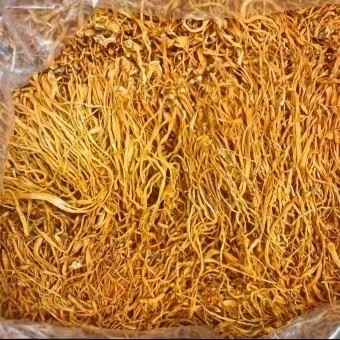
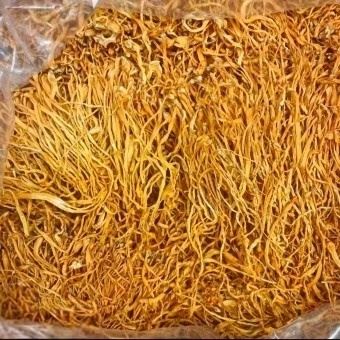
When you look at a batch of high-quality dried cordyceps flower, the first thing you’ll notice is its uniform golden-yellow color. It’s not brown, it’s not pale beige, and it has consistent hue across every stem—one of the key signs of a well-dried, high-grade product. Lower-quality dried cordyceps flower, by contrast, often has uneven coloring, with pale white or brown stems, which usually means it was dried at too high a temperature or harvested when it was past its prime.
Next, the shape: each individual piece is 2 to 5 inches long, with a thin, slightly rigid stem (about the thickness of a spaghetti noodle, give or take) topped with a delicate, branched head. The heads are made up of dozens of tiny, thread-like filaments that fan out, creating that iconic “flower” shape. Some pieces will have two or three small branching heads, while others have a single, compact cluster—both are normal, and both are high quality, as long as the filaments are intact, not broken or crumbly. When bundled together, dried cordyceps flower looks like a bunch of tiny, delicate yellow stems, similar to a bundle of dried herbs like chamomile or linden flowers, but with the texture of a dry, fibrous mushroom.
One common misconception I hear from new buyers is that dried cordyceps flower is the same as dried cordyceps militaris. They’re related, but their appearance is very different. Dried cordyceps militaris, when properly dried, is a denser, shorter, brownish-orange mushroom, with a solid, club-shaped head and a thicker, sturdier stem. It looks more like a small, elongated pincushion than a flower, whereas dried cordyceps flower is all about that delicate, branching, wispy structure. That’s not to say one is better than the other—they have slightly different nutritional profiles, and they’re used for different things—but their appearances are distinct. You can browse our selection of dried cordyceps militaris here: Dried Cordyceps Militaris, if you’re looking for that denser, more traditional mushroom.
Another key feature of dried cordyceps flower is its subtle aroma, which is easy to miss but important to note when assessing quality. High-quality dried cordyceps flower has a mild, earthy, slightly sweet aroma, with no musty or moldy smells. If it smells sour or like damp wood, that’s a sign it was improperly dried, exposed to moisture, or stored incorrectly—something we work hard to avoid at our facility, where we control humidity and temperature to keep every batch at the ideal 10 to 12 percent moisture content. The moisture content is critical: too much moisture and the mushroom will spoil, too little and it will be brittle and crumbly, losing its delicate shape and nutritional value.
When rehydrated, dried cordyceps flower changes back to its tender, fresh-like state, but with a few small appearance tweaks. After soaking in warm water for 15 to 20 minutes, the golden-yellow color deepens to a richer, more vibrant yellow, the filaments plump up, and the texture becomes soft but still holds its shape, making it perfect for adding to soups, stir-fries, teas, or even as a garnish for bowls and salads. Many of our customers tell me that when they cook it, it looks like tiny yellow flowers floating in their soup—visually appealing, even before you taste it.
As a supplier, I’ve seen a lot of variations in dried cordyceps flower over the years, and the biggest takeaway I want to share is that appearance is a reliable indicator of quality. If you’re shopping for dried cordyceps flower, look for uniform golden-yellow color, intact branching filaments, no broken pieces or discolored stems, and a mild, fresh aroma. If it looks dull, crumbly, or has uneven coloring, it’s probably a lower-grade product that won’t offer the same flavor or nutritional benefits.
If you’re looking to source high-quality dried cordyceps flower for your wellness brand, restaurant, or personal use, we test every batch for purity and quality, so you can trust you’re getting a product that’s not only beautiful but also safe and effective. We work with small-scale, sustainable farms that follow strict organic practices, and our drying process is designed to preserve every bit of the mushroom’s natural goodness. Whether you’re looking for a small sample to test or bulk orders for large-scale use, we’re here to help.
Don’t settle for subpar dried cordyceps flower that’s been dried too hot or stored improperly. When you choose a supplier who cares about every detail of the mushroom’s appearance and quality, you get a product that’s as good on the eyes as it is for your wellness routine. Reach out to our team to discuss your requirements, whether you’re a retailer looking to add this versatile mushroom to your shelves, a chef wanting to incorporate it into seasonal dishes, or a wellness enthusiast sourcing for personal use.
References:
- Jones, M. et al. (2021). Cultivated Cordyceps: Appearance, Processing, and Nutritional Quality. Journal of Edible Fungi and Medicinal Mushrooms, 9(2), 112-120.
- Lee, S. et al. (2019). Comparison of Drying Methods for Cordyceps militaris and Related Strains. Food Science and Technology International, 25(4), 321-330.
- World Health Organization (2018). Traditional Medicinal Fungi: Cultivation, Quality Control, and Safety. WHO Regional Office for Western Pacific.
- Chen, L. et al. (2020). Distinguishing Commercial Cordyceps Products: Morphological and Nutritional Markers. Journal of Agricultural and Food Chemistry, 68(37), 10045-10052.
Send Inquiry